Friday, April 13, 2012
Ever since I was a child I was interested in the Titanic. I was always a disaster movie queen I guess. Prior to the last Titanic craze in 1998, I researched and wrote biographies for the website Encyclopedia Titanica (which seems to be having problems lately).
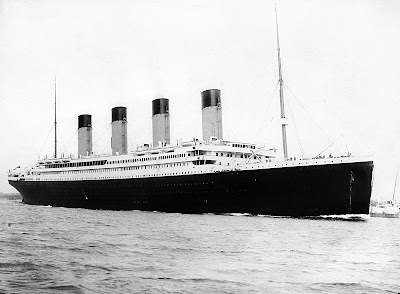
Titanic.
Recently I decided to prepare an undated entry for one of the passengers and chose a man who had a truly remarkable escape. The article I submitted to the website is below.
George Alexander Lucien Rheims was born on 6 January 1879 in New York City, New York, the son of Leon Rheims and Jeanette Kearns. His father was a French native who came to the United States in the late 1850s, while his mother was a New York native, born to French immigrant parents, they were married on 25 October 1867 in Brooklyn. On 1 June 1880, George’s parents and siblings- Rosalie (later Comtesse de Roussy de Sales), Gaston, Charles, Leon Jr., and Henry lived at 4 E. 30th Street in New York City. His father owned a millinery goods business and was quite wealthy, the family employed eight female servants.
George’s family often returned to France, and he lived there between 1883 and 1887. In January 1892, the family millinery import business suffered a tremendous loss when a fire occurred at numbers 5 through 9 in Union Square. Leon Rheims had between $200,000 and $250,000 in goods that were destroyed. The next month, an auction of the remaining stock, which included ostrich feathers, trimmings, plushes, and Florentine silks, was held. Afterward, George’s parents returned to Paris, although the Rheims millinery business continued, with stores in Paris, Boston, and New York City.
George’s father died in Paris on 31 January 1894, leaving an estate valued between $300,000 to $400,000 to his wife, with the five children to receive it after her death.
George returned to France and lived there for much of the time afterward, returning briefly to the United States in 1900 and 1905-1906. Passenger records list George Rheims arriving in the United States on numerous occasions, probably visiting family members and working at the family business. On 7 April 1906, George arrived in New York City after sailing on 31 March 1906 from Le Havre aboard the S. S. La Lorraine. He was working as a merchant and was “on a visit to the States.” On 5 October 1907, George and his brother Gaston Richard Rheims arrived about La Provence that had sailed from Le Havre on 28 September 1907. On 2 February 1910, George arrived in New York City on the Kaiser Wilhelm Der Grosse. He was listed as an importer. On 26 February 1911, he returned from Cherbourg, France aboard the Amerika. On 21 October 1911, George and a brother (whose name is illegible) arrived on La Provence from Havre.
 George Rheims, passport photo from 1915.
George was married in late 1911 or early 1912 to Marie Lamoine Loring. Marie was born on 21 September 1880 in Chicago, Illinois, daughter of Francis L. Loring and Williamana Holland. Her parents reportedly refused to accept Rheims. There is the likelihood that George was Jewish, and this may have been the causal factor (It appears that George's brother Leon was in France during World War II was executed by the Nazis for being Jewish)..

Marie Loring Rheims, passport photo from 1915.
George was living at 42 Rue de Paradis in Paris at the time he boarded the Titanic at Cherbourg with his brother-in-law, Joseph Holland Loring, on a voyage to New York City. He paid 39 pounds and 12 shillings for ticket 17604. The two men had adjoining staterooms on B deck. On the night of April 15th, George and Joseph were in the smoking room “trying to figure out the speed of the boat to see what the run would be the next day. Then the steward, whom I think they called the commodore steward, because I think he is the oldest steward, came up to us and said we might figure on a bigger run. We said, ‘Why?’ He answered, ‘Because we are making faster speed than we were yesterday.’ My brother-in-law said, ‘What do you know about it?’ He said, ‘I got it from the engine room.’ My brother-in-law said, ‘That don’t mean anything.’ He said, ‘Gentlemen, come out and see for yourself.” We went out in the passage hallway right outside of the smoking room and we stood there, and he said, ‘You notice that the vibration of the boat is much greater tonight than it has ever been.’ And we did notice the vibration, which was very strong that night, and my brother-in-law, whose stateroom was right underneath the passage, said, ‘I never noticed this vibration before; we are evidently making very good speed.”
After the collision with the iceberg, George said “no one seemed to know for twenty minutes after the boat struck that anything had happened. Many of the passengers stood round for an hour with their life belts on, he said, and saw people getting into the boats.” Rheims ran down to his stateroom and grabbed a picture of his wife from a frame. When he returned to deck, he and Loring stripped off their heavy clothing and prepared to enter the water towards the bow. Loring hesitated, considering heading to the stern. Rheims, in a letter he wrote to his wife afterward, claimed that he saw an officer commit suicide after announcing, “Gentlemen, each man for himself. Good-bye.”
In the pandemonium, as the Titanic’s bow dipped under, Rheims and Loring were separated and Rheims ended up near Collapsible Boat A. He later said that he shook hands with his brother-in-law, who would not jump, and leaped over the side of the boat. He swam for a quarter of an hour and reached a boat, with 18 occupants, half under water. The people were in water up to their knees. Seven of them, he said, died during the night.” Before crawling into the boat, Rheims had had to untangle himself from some deck chairs and a mass of rope. Another survivor in Collapsible Boat A would say that they saw Rheims standing in the boat in his underwear. Rheims later said he had to take charge of the boat, and that the occupants of Collapsible Boat A had to prevent additional people from climbing aboard. The 20 or so survivors aboard used pieces of boards to paddle away from the mass of people struggling in the water. On the initial survivor lists, telegraphed to shore, he was listed as “Mrs. George Rheims.” Afterward, some people would think he escaped the Titanic dressed as a woman.
George’s wife Marie was pregnant at the time of the disaster, and subsequently gave birth to their son George Loring Rheims on 29 July 1912 in Paris. In early 1913, George was one of many passengers who filed claims with the United States Commissioner Gilchrist. George reported that he “was on a submerged, defective collapsible lifeboat for hours, he says, and for shock and anguish, he demands $10,700; for baggage, $6418.” Among the items he claimed he lost were a turquoise scarf pin, a fur coat, eight suits of clothes, a fur rug, an umbrella, and 48 shirts.
George returned to live in France afterward. He, wife Maria, and son Loring returned to New York City on 16 October 1914 aboard the Mauretania. On 1 October 1901, George and Marie arrived in New York City from Liverpool, England aboard the St. Paul. George frequently traveled abroad for business, with passport applications existing for 1914, 1915, 1917, 1918, and 1920. These provide biographical information, as well as physical descriptions (and in some cases blurry photographs (e.g., 1915 and 1920)). As an example, he applied for a passport in December 1915. He reported that he was 5 ft 11 inches tall, had a broad forehead, brown eyes, a straight nose, a medium mouth, a round chin, very dark brown hair (balding by 1920), a ruddy complexion, and a round face. He noted that he was employed by the Leon Rheims Company, Importers, at 417 5th Avenue in New York City and that he and his wife were traveling to France and England for the importing business. By June 1917, the company was renamed George Rheims & Cie. and George was living in Paris, occasionally visiting England on business. He left the United States again in March 1918, arriving in France on 5 April 1918. In November 1918, he applied for a temporary permit to visit Switzerland while residing in France. George arrived on 1 January 1919 aboard the S. S. Espagne, leaving Bordeau, France on 21 December 1918.
br />

In November 1930, George attended a luncheon at the Olympic Hotel in Seattle. His wife attended a luncheon in Seattle in January 1931. In 1936, the couple lived in Pasadena, California. They frequently traveled back and forth between Pasadena and Seattle. As war began on the European continent, George, Maria, and their son George returned to the United States from Lisbon, Portugal on 18 October 1940 aboard the Exeter.
During World War II, George and Marie’s son George enlisted at Fort Dix, New Jersey on 14 March 1942. He was single at the time and reported that he had attended college for four years. He served as a Captain in the Headquarters of the 2nd Infantry Division during the war. After his death on 11 June 1964, he would be buried in Arlington National Cemetery in Washington, D.C. George was required to register for the draft in the World War II in 1942. At that time he was retired and was living in the Exeter Hotel in Seattle, Washington. In 1945, his sister, “Countess J. de Roussy de Sales,” visited Seattle and stayed with George and his wife. She had fled France during the war as a refugee and was known for her work with the French Red Cross. The following year saw a visit from the couple’s son George, his French wife Anne, and their son, George III. George’s sister Lily died in October 1948.
In February 1950, George and Marie sold the Exeter Hotel and moved to Biarritz, France. Marie died there on 8 August 1954. She left behind an estate valued at over $100,000. George was later married to Dolores Maria Josefa Lolita Candela in Biarritz. He died there on 1 March 1963 from myocardial infarction with pulmonary oedemia. He was buried in plot #76-1892 in the Passy’s Cemetery in Paris. He left his Seattle properties, valued at over $400,000 to his wife and grandson George Loring Rheims, with smaller bequests to his nephew Richard de Roussy de Sales and three Seattle friends.

Titanic.
Recently I decided to prepare an undated entry for one of the passengers and chose a man who had a truly remarkable escape. The article I submitted to the website is below.
George Alexander Lucien Rheims was born on 6 January 1879 in New York City, New York, the son of Leon Rheims and Jeanette Kearns. His father was a French native who came to the United States in the late 1850s, while his mother was a New York native, born to French immigrant parents, they were married on 25 October 1867 in Brooklyn. On 1 June 1880, George’s parents and siblings- Rosalie (later Comtesse de Roussy de Sales), Gaston, Charles, Leon Jr., and Henry lived at 4 E. 30th Street in New York City. His father owned a millinery goods business and was quite wealthy, the family employed eight female servants.
George’s family often returned to France, and he lived there between 1883 and 1887. In January 1892, the family millinery import business suffered a tremendous loss when a fire occurred at numbers 5 through 9 in Union Square. Leon Rheims had between $200,000 and $250,000 in goods that were destroyed. The next month, an auction of the remaining stock, which included ostrich feathers, trimmings, plushes, and Florentine silks, was held. Afterward, George’s parents returned to Paris, although the Rheims millinery business continued, with stores in Paris, Boston, and New York City.
George’s father died in Paris on 31 January 1894, leaving an estate valued between $300,000 to $400,000 to his wife, with the five children to receive it after her death.
George returned to France and lived there for much of the time afterward, returning briefly to the United States in 1900 and 1905-1906. Passenger records list George Rheims arriving in the United States on numerous occasions, probably visiting family members and working at the family business. On 7 April 1906, George arrived in New York City after sailing on 31 March 1906 from Le Havre aboard the S. S. La Lorraine. He was working as a merchant and was “on a visit to the States.” On 5 October 1907, George and his brother Gaston Richard Rheims arrived about La Provence that had sailed from Le Havre on 28 September 1907. On 2 February 1910, George arrived in New York City on the Kaiser Wilhelm Der Grosse. He was listed as an importer. On 26 February 1911, he returned from Cherbourg, France aboard the Amerika. On 21 October 1911, George and a brother (whose name is illegible) arrived on La Provence from Havre.

George was married in late 1911 or early 1912 to Marie Lamoine Loring. Marie was born on 21 September 1880 in Chicago, Illinois, daughter of Francis L. Loring and Williamana Holland. Her parents reportedly refused to accept Rheims. There is the likelihood that George was Jewish, and this may have been the causal factor (It appears that George's brother Leon was in France during World War II was executed by the Nazis for being Jewish)..

Marie Loring Rheims, passport photo from 1915.
George was living at 42 Rue de Paradis in Paris at the time he boarded the Titanic at Cherbourg with his brother-in-law, Joseph Holland Loring, on a voyage to New York City. He paid 39 pounds and 12 shillings for ticket 17604. The two men had adjoining staterooms on B deck. On the night of April 15th, George and Joseph were in the smoking room “trying to figure out the speed of the boat to see what the run would be the next day. Then the steward, whom I think they called the commodore steward, because I think he is the oldest steward, came up to us and said we might figure on a bigger run. We said, ‘Why?’ He answered, ‘Because we are making faster speed than we were yesterday.’ My brother-in-law said, ‘What do you know about it?’ He said, ‘I got it from the engine room.’ My brother-in-law said, ‘That don’t mean anything.’ He said, ‘Gentlemen, come out and see for yourself.” We went out in the passage hallway right outside of the smoking room and we stood there, and he said, ‘You notice that the vibration of the boat is much greater tonight than it has ever been.’ And we did notice the vibration, which was very strong that night, and my brother-in-law, whose stateroom was right underneath the passage, said, ‘I never noticed this vibration before; we are evidently making very good speed.”
After the collision with the iceberg, George said “no one seemed to know for twenty minutes after the boat struck that anything had happened. Many of the passengers stood round for an hour with their life belts on, he said, and saw people getting into the boats.” Rheims ran down to his stateroom and grabbed a picture of his wife from a frame. When he returned to deck, he and Loring stripped off their heavy clothing and prepared to enter the water towards the bow. Loring hesitated, considering heading to the stern. Rheims, in a letter he wrote to his wife afterward, claimed that he saw an officer commit suicide after announcing, “Gentlemen, each man for himself. Good-bye.”
In the pandemonium, as the Titanic’s bow dipped under, Rheims and Loring were separated and Rheims ended up near Collapsible Boat A. He later said that he shook hands with his brother-in-law, who would not jump, and leaped over the side of the boat. He swam for a quarter of an hour and reached a boat, with 18 occupants, half under water. The people were in water up to their knees. Seven of them, he said, died during the night.” Before crawling into the boat, Rheims had had to untangle himself from some deck chairs and a mass of rope. Another survivor in Collapsible Boat A would say that they saw Rheims standing in the boat in his underwear. Rheims later said he had to take charge of the boat, and that the occupants of Collapsible Boat A had to prevent additional people from climbing aboard. The 20 or so survivors aboard used pieces of boards to paddle away from the mass of people struggling in the water. On the initial survivor lists, telegraphed to shore, he was listed as “Mrs. George Rheims.” Afterward, some people would think he escaped the Titanic dressed as a woman.
George’s wife Marie was pregnant at the time of the disaster, and subsequently gave birth to their son George Loring Rheims on 29 July 1912 in Paris. In early 1913, George was one of many passengers who filed claims with the United States Commissioner Gilchrist. George reported that he “was on a submerged, defective collapsible lifeboat for hours, he says, and for shock and anguish, he demands $10,700; for baggage, $6418.” Among the items he claimed he lost were a turquoise scarf pin, a fur coat, eight suits of clothes, a fur rug, an umbrella, and 48 shirts.
George returned to live in France afterward. He, wife Maria, and son Loring returned to New York City on 16 October 1914 aboard the Mauretania. On 1 October 1901, George and Marie arrived in New York City from Liverpool, England aboard the St. Paul. George frequently traveled abroad for business, with passport applications existing for 1914, 1915, 1917, 1918, and 1920. These provide biographical information, as well as physical descriptions (and in some cases blurry photographs (e.g., 1915 and 1920)). As an example, he applied for a passport in December 1915. He reported that he was 5 ft 11 inches tall, had a broad forehead, brown eyes, a straight nose, a medium mouth, a round chin, very dark brown hair (balding by 1920), a ruddy complexion, and a round face. He noted that he was employed by the Leon Rheims Company, Importers, at 417 5th Avenue in New York City and that he and his wife were traveling to France and England for the importing business. By June 1917, the company was renamed George Rheims & Cie. and George was living in Paris, occasionally visiting England on business. He left the United States again in March 1918, arriving in France on 5 April 1918. In November 1918, he applied for a temporary permit to visit Switzerland while residing in France. George arrived on 1 January 1919 aboard the S. S. Espagne, leaving Bordeau, France on 21 December 1918.
br />

George Rheims, 1923 passport photo.
In November 1930, George attended a luncheon at the Olympic Hotel in Seattle. His wife attended a luncheon in Seattle in January 1931. In 1936, the couple lived in Pasadena, California. They frequently traveled back and forth between Pasadena and Seattle. As war began on the European continent, George, Maria, and their son George returned to the United States from Lisbon, Portugal on 18 October 1940 aboard the Exeter.
During World War II, George and Marie’s son George enlisted at Fort Dix, New Jersey on 14 March 1942. He was single at the time and reported that he had attended college for four years. He served as a Captain in the Headquarters of the 2nd Infantry Division during the war. After his death on 11 June 1964, he would be buried in Arlington National Cemetery in Washington, D.C. George was required to register for the draft in the World War II in 1942. At that time he was retired and was living in the Exeter Hotel in Seattle, Washington. In 1945, his sister, “Countess J. de Roussy de Sales,” visited Seattle and stayed with George and his wife. She had fled France during the war as a refugee and was known for her work with the French Red Cross. The following year saw a visit from the couple’s son George, his French wife Anne, and their son, George III. George’s sister Lily died in October 1948.
In February 1950, George and Marie sold the Exeter Hotel and moved to Biarritz, France. Marie died there on 8 August 1954. She left behind an estate valued at over $100,000. George was later married to Dolores Maria Josefa Lolita Candela in Biarritz. He died there on 1 March 1963 from myocardial infarction with pulmonary oedemia. He was buried in plot #76-1892 in the Passy’s Cemetery in Paris. He left his Seattle properties, valued at over $400,000 to his wife and grandson George Loring Rheims, with smaller bequests to his nephew Richard de Roussy de Sales and three Seattle friends.
Thursday, April 12, 2012
It was already sunset when I picked Jimbo, Glenn, and Brian up at their hotel. We drove west over Gates Pass and paused in the parking lot beyond so they could admire the view. The photos I took were, of course, somewhat dark.
 Jim, Brian, and Glenn.
Afterward, we drove east to have supper at Rosa's. I swear, I gain a pound by just walking in the door.
 Jim enjoys a margarita.
It was nice to have a night off from entertaining my mother. I suggested she heat up some Trader Joe Biryani rice for supper (which she really likes), but instead she had a bowl of cereal.
I woke up with a painful neck, probably a result of a cat walking across my face in the middle of the night and my startled reaction to said event. It is painful enough that I would almost stay home from work, but with my mother here, I wouldn't get much rest.

Afterward, we drove east to have supper at Rosa's. I swear, I gain a pound by just walking in the door.

It was nice to have a night off from entertaining my mother. I suggested she heat up some Trader Joe Biryani rice for supper (which she really likes), but instead she had a bowl of cereal.
I woke up with a painful neck, probably a result of a cat walking across my face in the middle of the night and my startled reaction to said event. It is painful enough that I would almost stay home from work, but with my mother here, I wouldn't get much rest.
Tuesday, April 10, 2012
My backyard is a fiesta of pretty flowers. I don't remember this one cactus blooming before, and now it is loaded with red blossoms.
 Red prickly pear cacti.
Some purple asters are sprinkled throughout the backyard.
 Purple aster.
Went and got my hairs chopped by Paul today. I will be attending a conference in Memphis next week, so I have to look nice.
 I'm down 21 pounds since late January.

Some purple asters are sprinkled throughout the backyard.

Went and got my hairs chopped by Paul today. I will be attending a conference in Memphis next week, so I have to look nice.

Sunday, April 08, 2012
Let's make mulberry jam.
First, pick a bunch of mulberries. Wash them and remove debris and the green mulberries that fell in your colander. I needed five cups, so I have to add some strawberries.
 Mulberries and strawberries.
Of course I didn't read the directions correctly, I was supposed to add the seven cups of sugar after the berries boiled, but in the end it still worked.
 Berries cooking.
While the berries cooked I was preparing the bottles and lids.
 Boil!
Boil!
I now have four small and two large bottles of delicious jam.
 Mulberry jam!

Of course I didn't read the directions correctly, I was supposed to add the seven cups of sugar after the berries boiled, but in the end it still worked.

While the berries cooked I was preparing the bottles and lids.

I now have four small and two large bottles of delicious jam.

Mummy wanted to go to the Zoo. So we got in the car and went.
Tucson's Reid Park Zoo has perhaps a couple of dozen species, many endangered. I am somewhat surprised that there isn't a greater effort to breed some of more critical species, like the Southern White Rhino.
Anyways, we wandered past several exhibits which were being cleaned out. Amid the screeching peacocks, were some zebras and ostriches.
 Grevy's zebra.
A few large birds wandered around.
 Maribou stork.
My favorite are the giraffes. Last year, one of them was accidentally fed some oleander leaves and died.
 Mother and giraffe.
These are Reticulated Giraffes.

There are nine different giraffe sub-species.
We reached the new elephant exhibit. I was impressed by the enormous bull elephant.
 Bull!
Bull!
Mother, who has been feeling poorly lately, decided to get sick and we had to come home. She was very drama-filled. When we were in Flagstaff she had a gluten-free pizza that was apparently contaminated. The last two weeks have been filled with unpleasantness. Once she got home she seemed to be better, I am busy feeding her bland and dull foods.

A few large birds wandered around.

My favorite are the giraffes. Last year, one of them was accidentally fed some oleander leaves and died.

These are Reticulated Giraffes.

There are nine different giraffe sub-species.
We reached the new elephant exhibit. I was impressed by the enormous bull elephant.

Saturday, April 07, 2012
When I walked out of the gym this morning I walked past the trees in the courtyard and realized the mulberry tree was loaded with mulberries. I picked a few- they were delicious.
After supper, I headed back over with a collander, put my headphones on, and started picking berries. The handful of people around must have thought I was crazy. A German tourist came up to ask me where everyone was (downtown is largely deserted at night, I sent him down to 4th Avenue).
My fingers are stained purple. I think I have enough to make 3 or 4 small pint jars of jam. I will probably do this tomorrow.
 Mulberries.
We used to pick mulberries when I was a kid, or rather, we'd spread an old sheet on the ground and shake the branches until the loose berries fell off. I was reminded of this as many berries fell off the branches and onto the ground as I was attempting to harvest them.

We used to pick mulberries when I was a kid, or rather, we'd spread an old sheet on the ground and shake the branches until the loose berries fell off. I was reminded of this as many berries fell off the branches and onto the ground as I was attempting to harvest them.
Tuesday, April 03, 2012
The National Archives released the 1940 census yesterday, 72 years after it was taken.
Today I went to the National Archives website and hunted down the records for my parents.
I found my father, listed under his biological father's surname, in Garfield township. His mother had just divorced her first husband (who was living in Traverse City with his parents), and would soon marry the hired man (the neighbors were busy gossiping that the two were having an affair).

Grandmother Alice, her soon-to-be second husband, my father, and my aunt.
Almost all of the neighbors were people who were still living there 30 years later, back when I was a small child.
My mother was living on Washington Street with her parents and brothers. Grandpa was a lineman for Michigan Bell.
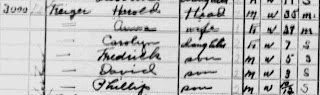
My maternal grandparents, my mother, and her three brothers.
The following month, in May, my mother's great aunt Ada Kate Ransom Morton brought three small swatches of cloth and Mummy was allowed to pick one. It had green and white stripes and small hearts of different colors in the white stripes. Grandma sewed my mother a dress from this, but didn't put any pockets on it because she thought my mother would stick her hands in and tear them off the dress. Mummy told me this story as we looked at the census records together.
I found my father, listed under his biological father's surname, in Garfield township. His mother had just divorced her first husband (who was living in Traverse City with his parents), and would soon marry the hired man (the neighbors were busy gossiping that the two were having an affair).

Grandmother Alice, her soon-to-be second husband, my father, and my aunt.
Almost all of the neighbors were people who were still living there 30 years later, back when I was a small child.
My mother was living on Washington Street with her parents and brothers. Grandpa was a lineman for Michigan Bell.

The following month, in May, my mother's great aunt Ada Kate Ransom Morton brought three small swatches of cloth and Mummy was allowed to pick one. It had green and white stripes and small hearts of different colors in the white stripes. Grandma sewed my mother a dress from this, but didn't put any pockets on it because she thought my mother would stick her hands in and tear them off the dress. Mummy told me this story as we looked at the census records together.
Sunday, April 01, 2012
The Non-Denominational Egg Decorating and Backyard Egg Hunt party was a success. Albeit, one that started with a very stressful and disgusting incident, and although I had frantically worked for the last four days on a testing project with Allen and Dan, I was still able to get things together, thankfully with the able assistance of my handsome man Evan.
We made potato salad, 2-bean salad, pimento cream-cheese stuffed celery (a surprising hit), butterscotch pudding, and a gluten-free carrot cake (Namaste brand spice cake, highly recommended).
The first guests arrived and I had Patrick mix the colors.

My mother was especially excited to have Milo and Nathan arrive..

 Mummy watches as Milo looks at his basket.


 Along the side yard.


Evan won through hard work, he found many more eggs than the others. Second and third place were only separated by three points!
Patrick and Steve took this year off, but next year they will have to once again participate.

Doug, Patrick, and Cobban.
My mother was especially excited to have Milo and Nathan arrive..

Tara explains to Milo how you decorate eggs.


Nathan's first egg hunt.

Allen decorates.
What am I going to do with all the eggs?

Egg Hunters, ready to go.


Ray, Doug, and Evan grab eggs.

The winners- 3rd place Sandy, 1st Evan, and 2nd Jesse.
Evan won through hard work, he found many more eggs than the others. Second and third place were only separated by three points!
Patrick and Steve took this year off, but next year they will have to once again participate.
Tuesday, March 27, 2012
Spring time has arrived and the animals are mating outside my office window. A vermillion flycatcher swoops through the air, catching bugs to eat.
 Vermillion flycatcher.
At home, my backyard is loaded with a dozen different types of wildflowers and flowering bushes.
 Brittle bush.
Bees were buzzing around as I watered.
 Fairy duster.
Some of the plants were apparently planted by birds pooping out seeds. Every year I get one or two new varieties.
 Purple flower.
I was out this morning doing some yardwork. My egg party is Sunday and I have to get things ready for the egg hunt.
 Penstamen and macrame owl.
Wednesday through Saturday I have a testing project in parking lots. I hope something interesting turns up.

At home, my backyard is loaded with a dozen different types of wildflowers and flowering bushes.

Bees were buzzing around as I watered.

Some of the plants were apparently planted by birds pooping out seeds. Every year I get one or two new varieties.

I was out this morning doing some yardwork. My egg party is Sunday and I have to get things ready for the egg hunt.

Sunday, March 25, 2012
We went to the Grand Canyon yesterday and I am worn out.

The Grand Canyon is both. At times, it is difficult to look over the side, so far down.

The park sells a book in the gift shops that details every single person who died in the park. I was glad no one fell over the cliff while I was there. People certainly do stupid things.

We also went to Walnut Canyon, but I forgot my camera in the car.

At times I was a bit short with my mother, who is acting her age and some. When we got home I took a nap, which ended when she started making noises in the kitchen. When I walked in, I discovered she had cut opened the gel freezer pack that goes into the cooler and was squeezing it into a bowl, since she had decided it was edible (it had a picture of a strawberry on it). I was not amused.
She has been here for four months and a week, and I am ready to have the place to myself again.

Evan and Mummy.
The Grand Canyon is both. At times, it is difficult to look over the side, so far down.

Click on the picture to see it better.

We also went to Walnut Canyon, but I forgot my camera in the car.

She has been here for four months and a week, and I am ready to have the place to myself again.
Monday, March 19, 2012
I went to an antique store with Mummy yesterday. I went through a huge stack of carte de vista photographs, looking for those with names on the back or handsome unidentified men.
 Alva Cole, taken on 31 December 1888.


Unidentified man (click to see better, he's good looking).

Unidentified man with nice moustache.
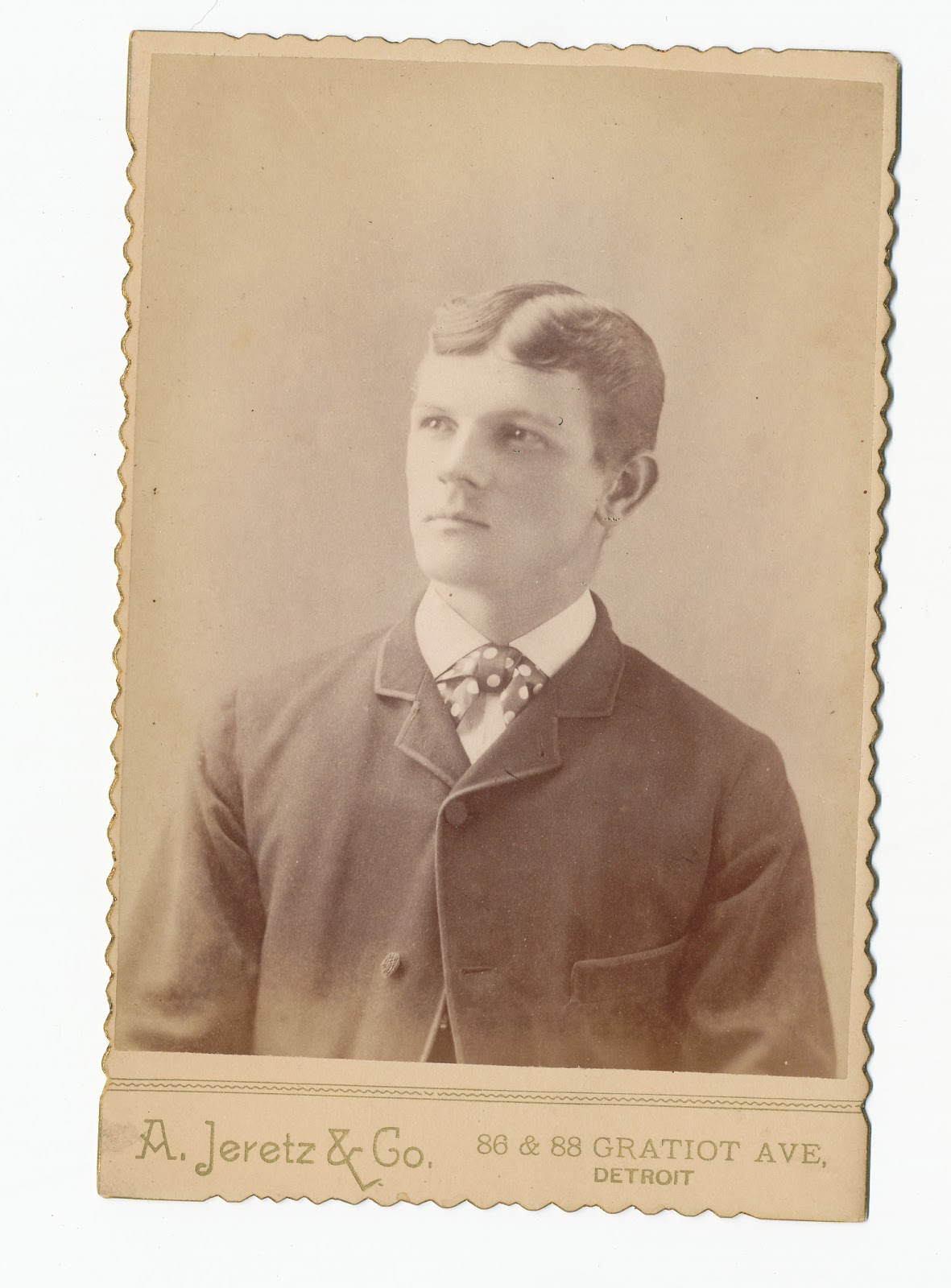
John J. Kink.
I have started researching the named people, and found memorials for two of them on the FIndagrave.com website.
This was my radical homosexual lifestyle agenda for last night.
Friday, March 16, 2012
Today is my half-birthday. It really ought to be a national holiday.
So let's see. Inside now, writing stuff at work, making a Power Point (I am horrible at doing so), and feeling antsy. While I mainly do historical archaeology, I suddenly find myself interested in prehistoric archaeology. The structures and ceramics from my dig at the old fort were very interesting.
Still plugging away at the gym and watching what I eat. I am down about 20 pounds since January 24. Four more months before I get re-tested for cholesterol.
Mummy is here for another month. She continues to be extremely picky about her food and I am completely out of ideas. Mashed potatoes will be served tonight.
So let's see. Inside now, writing stuff at work, making a Power Point (I am horrible at doing so), and feeling antsy. While I mainly do historical archaeology, I suddenly find myself interested in prehistoric archaeology. The structures and ceramics from my dig at the old fort were very interesting.
Still plugging away at the gym and watching what I eat. I am down about 20 pounds since January 24. Four more months before I get re-tested for cholesterol.
Mummy is here for another month. She continues to be extremely picky about her food and I am completely out of ideas. Mashed potatoes will be served tonight.
Tuesday, March 13, 2012
At the end of most digs there are surprises. One of these was the discovery of burned daub (mud) that once plastered the inside of a house, burned hard when the house burned down about 1000-years-ago. You can still see the fingerprints of an ancient person on the daub.
 Finger prints. Click on the pictures to see bigger versions, with more details.
On the south side of the area with prehistoric features we found a rectangular house, the walls lined with adobe and covered with plaster. We hurridly excavated it, recording the soil layers and exposing the floor, on which lay a broken decorated jar and several grinding stones.
 Feature 160 with floor artifacts.
Jeff and Olivia mapped the house, photographed the floor artifacts in place, and then removed them. We carefully document everything on forms, maps, and photographs, collecting the information for future archaeologists to examine.


Feature 164, after removal of artifacts.


On the south side of the area with prehistoric features we found a rectangular house, the walls lined with adobe and covered with plaster. We hurridly excavated it, recording the soil layers and exposing the floor, on which lay a broken decorated jar and several grinding stones.

Jeff and Olivia mapped the house, photographed the floor artifacts in place, and then removed them. We carefully document everything on forms, maps, and photographs, collecting the information for future archaeologists to examine.

Feature 160, completed.
Allen was examining the area just to the west of the house, and noticed another line of adobe. It turned out to be another, smaller rectangular structure. It was very shallow and we were able to quickly excavate it on Friday afternoon, exposing a broken jar and several pieces of ground stone on its floor.

Feature 164, with floor artifacts in place.
This structure differed from all of the others on the site because it did not have a hearth. When we removed the floor artifacts, we discovered five hollowed out areas on the floor, which we call pot rests. They are the spots where round-bottomed jars were once set. The structure turned out to be a storage building.

Feature 164, after removal of artifacts.
We found many pieces of burnt daub in these houses with impressions of beams and the materials used for the walls and roof. This sort of architectural information allows us to figure out how the long-disappeared super structure was put together.
We cleared some of the area in front of the houses, but did not find any other structures (although they may lie hidden beneath nearby trees or the backdirt pile). The dwelling and storage house, which probably date to around AD 1150, provide a great deal of information about the settlement of the area at that time.

Both houses.
Thursday, March 08, 2012
My co-worker Henry flew over the old fort site in a helicopter and took photos yesterday. Click on the pictures to see them in greater detail.
The fort was occupied between 1873 and 1891. The buildings were sold off in 1896 and the three officer's quarters in the southwestern corner of the fort became a tuberculosis rest home. Soon, the ruin on the right will have a protective roof to halt its gradual erosion.
.jpg) The small squares are planting pits from a garden next to two of the officer's quarters.
The small squares are planting pits from a garden next to two of the officer's quarters.
At the north side of the property, Chris and Steve completed a small prehistoric pit structure. Chris excavated the entrance way and found a red-on-brown bowl lying upside-down, apparently sitting on the roof of the structure when it burned and collapsed.

All five of the houses that we have excavated have been different. Here is the one Jeff and Olivia dug, with the many postholes.
.jpg)
We started the last house that we will dig yesterday. As Henry flew over in the helicopter I told everybody to look busy.
.jpg)
The fort was occupied between 1873 and 1891. The buildings were sold off in 1896 and the three officer's quarters in the southwestern corner of the fort became a tuberculosis rest home. Soon, the ruin on the right will have a protective roof to halt its gradual erosion.
.jpg)
At the north side of the property, Chris and Steve completed a small prehistoric pit structure. Chris excavated the entrance way and found a red-on-brown bowl lying upside-down, apparently sitting on the roof of the structure when it burned and collapsed.

The house is the smallest one we have found.
.jpg)
House in pit- the house was erected inside a pit, with the walls of the house inside the wall of the pit.
We started the last house that we will dig yesterday. As Henry flew over in the helicopter I told everybody to look busy.
.jpg)
I am in the white shirt.

